Justin Lemire est défait en prolongation à ses premiers mondiaux seniors
Montréal, 6 octobre 2026 – Opposé à des adversaires de taille, Justin Lemire ne s’en est pas laissé imposer à ses premiers…

Judo Canada
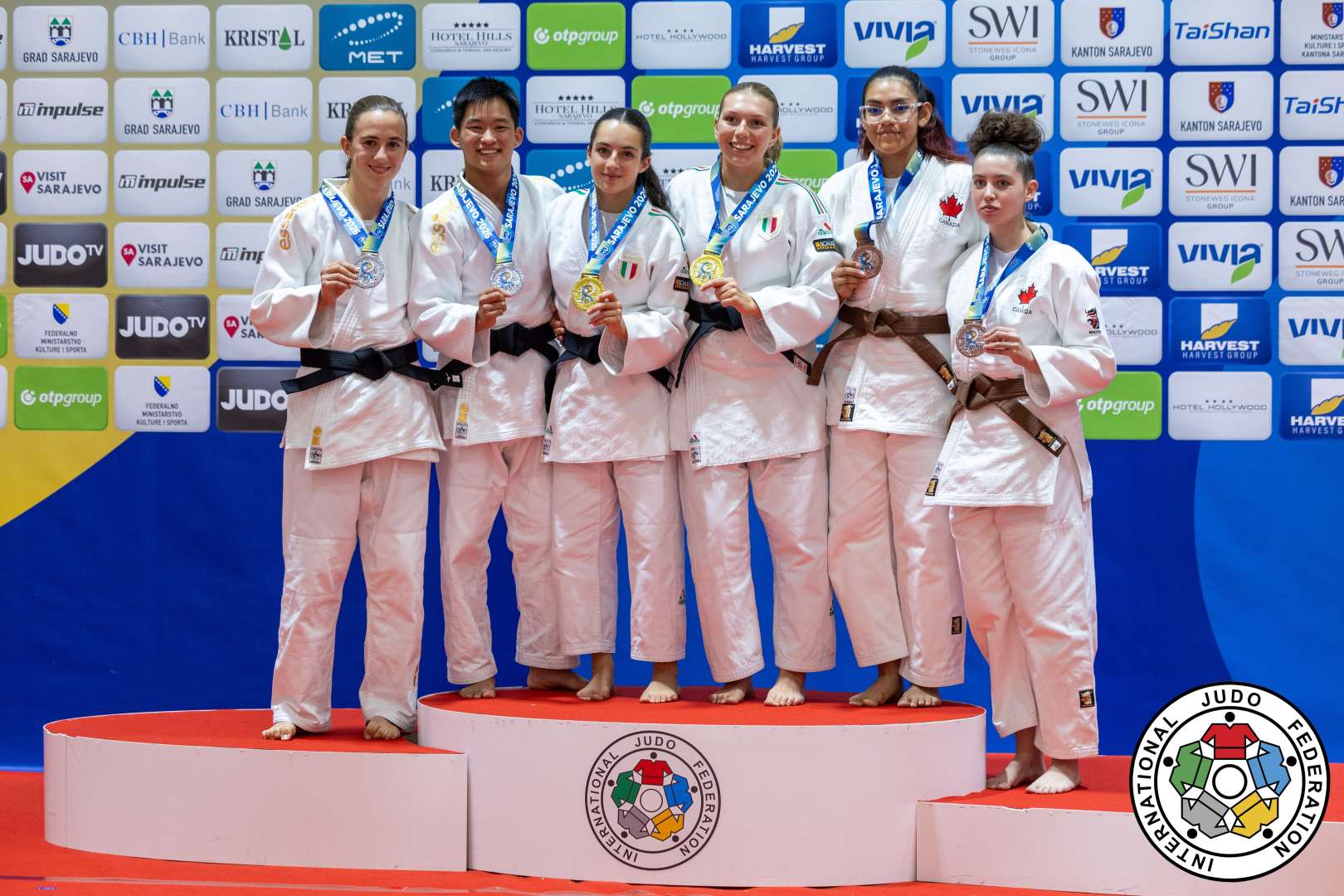
Gabriela Sabau / IJF
Montréal, 28 septembre 2026 (Judo Canada) – Le Canada était l’une des nations les mieux représentées cette fin de semaine lors des Championnats du monde de kata à Sarajevo, en Bosnie-Herzégovine. Une paire canadienne est parvenue à monter sur le podium, gracieuseté de Valentina Millan Rincon et Zoey Marie McIntosh, médaillées de bronze chez les moins de 23 ans en Ju-no-kata.
La performance des Ontariennes en finale leur a valu 351 points, soit seulement 0,5 de plus que les Espagnols Sara Fernandez Martinez et Alvaro Sanchez Resino, qui ont terminé au pied du podium.
Les Italiennes Sara Orlanda et Giulia Bezzi ont remporté l’épreuve grâce à 365,5 points, suivies des Espagnols Naroa Escanciano Lopez et Paul Garcia de Villota, médaillés d’argent avec 359,5 points.
Trois autres duos canadiens ont accédé à une finale en Bosnie-Herzégovine.
Shane Rooney et Xiao Kang Hu ont terminé huitièmes en Katame-no-kata avec 383,5 points, tout juste devant Ludovic Durrieu et Eric De Rome, qui ont récolté 367,5 points.
Chez les moins de 23 ans, les Québécois Isack Berger et Jean-Sébastien Roy ont inscrit 354,5 points en finale du Nage-no-kata, bon pour le septième rang. En ronde préliminaire, ils avaient réalisé le deuxième meilleur pointage de leur groupe.
« Évidemment, on se prépare pendant un an et on espère que tout ira pour le mieux. Dans l’ensemble, tout le monde était assez satisfait des performances. Mais les notes ne représentaient pas nécessairement ce qu’on espérait », a souligné le vétéran canadien Dan Rusu.
Certaines épreuves étaient particulièrement serrées, alors que des duos canadiens ont manqué la finale par quelques points seulement.
Rusu et son partenaire, Shane Legros, ont été stoppés en qualifications du Kime-no-kata. Ils ont terminé septièmes (474 points) d’un groupe particulièrement relevé.
« Des trois groupes en qualifications, nous avons probablement eu le plus difficile sur le plan des notes. Avec la note que nous avons obtenue, nous aurions possiblement accédé à la finale dans un autre groupe », a précisé l’Ontarien.
Dans la même épreuve, Mario Pageau et Remi Grenon-Turcotte ont terminé quatrièmes du groupe B grâce à une récolte de 458,5 points, tandis qu’Eric De Rome et Ludovic Durrieu ont pris le septième rang du groupe C avec 447,5 points.
En lice au Katame-no-kata, Kelly Palmer et Wesley Enns se sont classés sixièmes de leur groupe avec 361 points.
Palmer et Enns étaient également en action au Itsutsu-no-kata, où ils n’ont pas non plus réussi à se qualifier. Ils ont conclu l’épreuve au cinquième rang et une note de 148, à quelques points d’une place en finale. Dans le même tableau, John Mallory et Michael Melvin ont terminé septièmes avec 135,5 points. Edward Zupancic et Daniel Bird se sont aussi classés septièmes (150) de leur groupe.
Zupancic et Bird participaient également au Goshin Jutsu, où la paire a pris le sixième échelon de son groupe avec 477 points. Les sœurs Abigail et Olivia Flemming (471,5) étaient également en action dans cette même catégorie. Ivan Fournier et Pierre Pelletier ont pour leur part signé la meilleure performance canadienne au Goshin Jutsu avec une quatrième place et 485,5 points.
De leur côté, Simon Gauthier-Hensen et Juliette Mireault ont terminé septièmes en Ju-no-kata avec 391 points, soit sept de moins que la troisième et dernière place donnant accès à la finale.
Finalement, chez les moins de 23 ans, les Néo-Écossaises Abigail et Olivia Flemming ont pris le sixième rang de leur tableau au Nage-no-kata avec 344 points.
« Le kata gagne du terrain au Canada »
Le Canada était représenté par seize paires à Sarajevo, à égalité avec la France. Seule l’Italie comptait sur davantage de compétiteurs. En 2023, aux Championnats du monde d’Abou Dabi, huit duos canadiens étaient en lice. L’année précédente, il y en avait seulement cinq.
« Le kata gagne du terrain au Canada », s’est réjoui Dan Rusu. « C’est simplement dommage que la plupart des pratiquants soient d’un certain âge. Même moi, je pense à prendre ma retraite cette année et il n’y a pas beaucoup de relève à qui transmettre le flambeau », a-t-il ajouté.
Lors des deux derniers mondiaux, les médailles canadiennes ont été décrochées chez les moins de 23 ans. Si les juniors performent bien, ils ne sont toutefois pas suffisamment nombreux, a précisé Rusu. La formation de la relève sera un défi de taille dans les prochaines années.
« Ce n’est pas quelque chose qu’on peut faire du jour au lendemain en se disant : “On va faire du kata et le mois prochain on va gagner une médaille”. Ça demande des années et des années de dévouement et de pratique, mais je suis sûr que des jeunes prendront la relève », a conclu le vétéran.
-30-
Rédigé par Sportcom pour Judo Canada
Informations :
Patrick Esparbès
Directeur général adjoint
Judo Canada
(514) 668-6279
p.esparbes@judocanada.org
Montréal, September 28, 2026 (Judo Canada) – Canada was one of the best-represented nations this weekend at the World Kata Championships in Sarajevo, Bosnia and Herzegovina. Canadian duo Valentina Millan Rincon and Zoey Marie McIntoshstepped on the podium for a bronze medal in the Under-23 Ju-no-kata division.
The Ontarians’ performance in the final earned them 351 points, a scant 0.5 more than Spanish pair Sara Fernandez Martinez and Alvaro Sanchez Resino, who finished just off the podium.
Team Italy’s Sara Orlanda and Giulia Bezzi won the aforementioned event with 365.5 points, followed by another pair of Spanish judokas, Naroa Escanciano Lopez and Paul Garcia de Villota, who took silver with 359.5 points.
Notably, three other Canadian pairs advanced to a final round in Bosnia and Herzegovina, so there is promise for the future of Canadian judo kata.
Shane Rooney and Xiao Kang Hu finished eighth in Katame-no-kata with 383.5 points, followed by Ludovic Durrieu and Eric De Rome in ninth place, who scored 367.5 points.
In the Under-23 category, Québecers Isack Berger and Jean-Sébastien Roy scored 354.5 points in the Nage-no-kata final, good for seventh place. In the preliminary round, they earned the second-highest score in their group.
“Obviously, we’ve been preparing for worlds for a year and we hope everything will go well once we’re here. Overall, everyone was pretty satisfied with their performances. However, the scores didn’t necessarily reflect what we were hoping for,” noted Canadian veteran Dan Rusu.
Some events were exceptionally close, with Team Canada’s duos missing the final by just a few points.
Rusu and his partner, Shane Legros, were eliminated in the Kime-no-kata preliminaries. They finished seventh (474 points) but in a particularly competitive group.
“Of the three qualifying groups, we probably had the toughest in terms of scoring. With the score we got, we might have made it to the finals had we been in a different another group today,” the Ontarian explained.
In the same event, Mario Pageau and Remi Grenon-Turcotte finished fourth in Group B with 458.5 points, while Eric De Rome and Ludovic Durrieu ended their day in seventh place in Group C with 447.5 points.
Competing in the Katame-no-kata, Kelly Palmer and Wesley Enns placed sixth in their group with 361 points.
Palmer and Enns were also on the tatami for the Itsutsu-no-kata, where they likewise failed to qualify. They finished the event in fifth place (148), just a few points shy of a spot in the final. In the same bracket, John Mallory and Michael Melvin finished seventh with 135.5 points. Edward Zupancic and Daniel Bird also placed seventh (150) in their group.
Zupancic and Bird competed in Goshin Jutsu as well, where the pair placed sixth in their group with 477 points, the same ranking as Abigail Flemming and Olivia Flemming(471.5) in their respective group. In Goshin Jutsu, Ivan Fournier and Pierre Pelletierposted the best score for Team Canada with a fourth-place finish and total of 485.5 points.
Meanwhile, Simon Gauthier-Hensen and Juliette Mireault finished seventh in Ju-no-kata with 391 points—only seven points shy of the third and last available qualifying spot for the final.
Lastly, in the Under-23 division, Nova Scotians Abigail Flemming and Olivia Flemming took sixth place in their category in Nage-no-kata with 344 points.
“Kata is gaining popularity in Canada”
In Sarajevo, Canada was represented by sixteen pairs, tying athletes in attendance with France; only Italy had more judokas present. At the 2023 World Championships in Abu Dhabi, only eight Canadian pairs competed, the year before that, there were only five – climbing numbers are a positive trend.
“Kata is gaining popularity in Canada,” noted Dan Rusu said happily. “It’s just a shame that most of the athletes are getting older. Even I’m thinking about retiring this year, and there aren’t many young people coming up to take up the proverbial torch,” he added.
At the last two world championships, Team Canada’s medals were all won by judokas in the Under-23 division. However, even if the juniors are performing well, there simply aren’t enough of them, Rusu noted. As a result, developing the next generation of judo kata athletes represents a major challenge in coming years.
“It’s not something you can do overnight by saying, ‘We’ll practice kata, and next month we’ll win a medal.’ It takes years and years of dedication and practice. All the same, I’m sure young people will step up,” veteran Rusu concluded.
-30-
Written by Sportcom for Judo Canada
For more information:
Patrick Esparbès
Chief Operating Officer
Judo Canada
(514) 668-6279
Montréal, 6 octobre 2026 – Opposé à des adversaires de taille, Justin Lemire ne s’en est pas laissé imposer à ses premiers…
Montréal, 10 octobre 2026 – John Messe A Bessong était le dernier Canadien à combattre à l’ultime journée des compétitions individuelles aux…
Montréal, 9 octobre 2026 – Kyle Reyes a été le seul athlète du pays à signer une victoire à l’avant-dernière journée des…
Montréal, 25 septembre 2026 (Judo Canada) – À son sixième combat du jour des Championnats du monde de parajudo de Tbilissi, Priscilla…